
At ten past eight in Lagoa, the man ahead of you in the bakery is buying the same two rolls he bought yesterday. By half past nine in July, the heat has already decided the rest of your day.
That is the part the guides leave out. If you are researching retiring in Portugal, the visa steps are in a hundred places. Harder to find: the texture of an ordinary week, the tax position, and what buying here involves.
We are Antrix, and we build spaces that inspire, elevate, and endure.
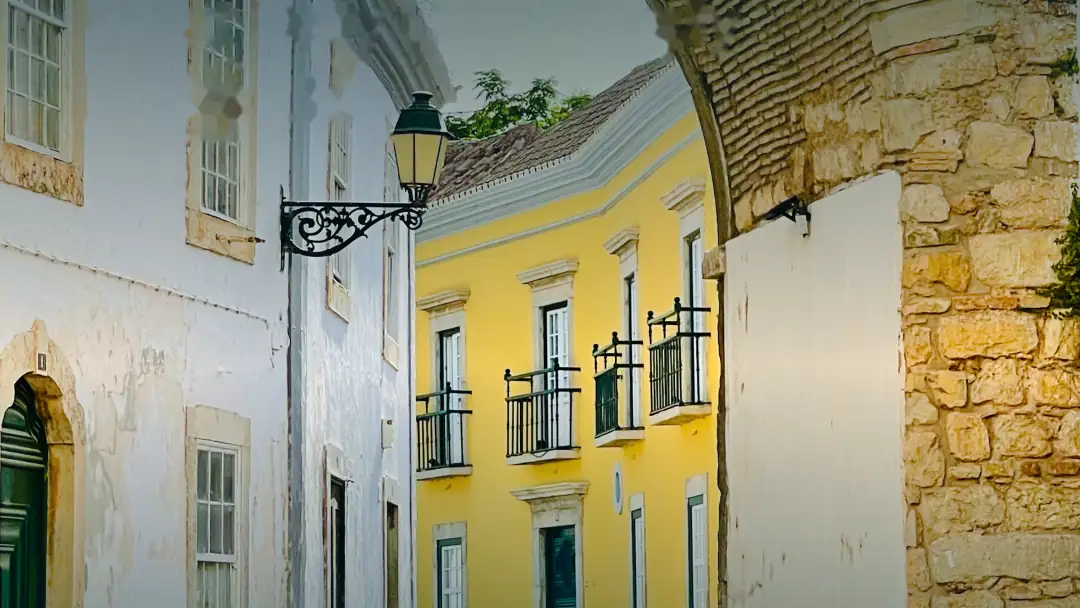
The region you arrive in on holiday and the region you live in are not the same place. On holiday the day is shaped by what you feel like doing; as a resident it is shaped by the market, the heat and the opening hours, and all three start early.
A weekday begins sooner than you expect. The bakery is busy by eight; by nine the cafés are full of people standing at the counter with a coffee and the queue at the health centre has formed. Anything needing another human being, the pharmacy, the town hall, a number taken from a ticket machine and a wait, is done before noon, because from one o’clock much of it closes for lunch and some does not reopen.
Market day is the fixed point of the week. Loulé, Olhão, Silves and Portimão all have covered markets, and the good fish is gone by eleven; so is the parking. Within a month you know which stall and which day.
Lunch is the meal that matters. It is long, it is the cheaper menu, and between half twelve and two the restaurants fill with people who work nearby. If you are going to meet anyone it happens here, or over a coffee afterwards. Not at dinner.
What happens after lunch depends entirely on the month, and so does the evening. This is where the two versions of the Algarve separate.
From late June to early September the coastal roads carry several times their normal traffic, and the approaches to Albufeira, Lagos and Vilamoura crawl between five and eight. The heat is dry and manageable if your house is right, punishing if it is not, and inland runs several degrees hotter. Afternoons belong to shade rather than the beach: residents swim at seven, visitors at two.
Then the evenings are long and the town comes back out. The seafront fills, the festas run through June, dinner at nine is normal. This is the version on the brochure, and it lasts about ten weeks.
Winter days are mild: sixteen to eighteen degrees in January is normal, and there are weeks in December when you eat outside at lunchtime. The mornings look much like the summer ones, minus the traffic, and by February there is almond blossom in the hills.
The evenings are another matter, for two reasons.
The first is the house. Portuguese housing stock was built to shed heat, not hold it: little insulation, single glazing, no heating. A house that is lovely in May can be 13°C and damp inside on a wet January night. A dehumidifier running in the hall is a normal part of winter here, in Portuguese and foreign-owned houses alike.
The second is the town. It is dark by six in December, and purpose-built resort towns lose most of their restaurants and much of their population between November and March. Working towns do not: Loulé, Silves, Tavira and Olhão still have a bakery, a doctor and a market in February.
Both weeks ask the same question. Can you get out of the house on foot, and is there anywhere open when you do? Some fill the dark months with a walking group, a Portuguese class, a café where the same four people turn up; others find them long. The difference is rarely the weather, and almost never the view. Which makes where you settle the first real decision.
Living in the Algarve is not one experience. A resort town gives you English everywhere, then empties for four months a year. A working town functions all year and asks more Portuguese of you in return. Inland buys space, quiet and a lower cost base at the cost of distance: the nearest hospital can be forty minutes away, and life without a car is close to impossible, a choice made at 65 for a life still being lived at 82.
The mistake is choosing on an August visit, when all three look the same.
Yes, measurably. Portugal ranks 7th in the Global Peace Index 2026, compiled by the Institute for Economics and Peace, a position held since 2023, and International Living’s Safest Places to Retire 2026 index places Portugal first in the world for retirement safety.
In practice that means walking home from dinner at eleven, in a town you barely know, and it being unremarkable. Opportunistic crime concentrates where you would expect: resort centres in August, beach car parks, handbags over chair backs. Bag snatching and vehicle break-ins are the realistic risks, not violence.
| Typical monthly range | |
|---|---|
| Total, including housing | €2,000 to €3,000 |
| Day to day, excluding housing | €800 to €1,200 |
| Housing (rent or mortgage equivalent) | €900 to €1,200 |
| One-bedroom in a cheaper town | around €700 |
| Private health insurance, couple in their 60s | €200 to €400 |
A comfortable Algarve retirement is usually not about the town. It is the house, and how it handles those two weeks.
South-facing gives you low winter sun deep into the room, and high summer sun you can block with an overhang. West-facing gives you the evening view and four hours of heat load in the rooms you most want to use at seven.
Fixed overhangs, external shutters and pergolas do the work, because they stop the heat before it reaches the glass; internal blinds do not. Openings on two sides of a room matter as much, letting the house flush its heat overnight.
A proper thermal envelope changes January completely. Continuous external insulation, double glazing and controlled ventilation hold the interior in the low twenties without heaters, and keep wall surfaces warm enough that moisture does not condense.
Most Algarve damp is not a leak but warm interior air meeting a cold uninsulated wall; fix the wall and the mould does not return. We cover this in our guide to how a house is built for this climate.
Most retirement houses are chosen for the life the buyer has now; the useful question is how it works at 80. Single-level living, or at minimum a bedroom and full bathroom on the entry level. Step-free thresholds, including out to the terrace, where the falls happen. Doorways wide enough for a walking frame. A shower with no tray to climb into, and solid wall backing for a grab rail later.
None of this has to look clinical, but it does have to be decided at the drawing stage: retrofitting costs several times as much.
If you can reach bread, coffee and a doctor on foot, your retirement has a floor under it. If you cannot, everything depends on driving, and driving is the thing most likely to change.
So check the actual walk, not the map distance: a pavement the whole way, shade at two in August, a café open in February. You can see how we approach siting across our Algarve developments.
The week above is the reward; the first year is mostly admin. This area changed materially in 2025 and 2026, so much of what is online is now wrong.
The D7 is the passive income route, open to any nationality: a minimum of €920 a month for a single applicant, roughly €11,040 a year, plus 50% for a spouse (about €460) and 30% per dependent child (about €276). Consulates increasingly want a six to twelve month income history rather than a lump sum, plus a buffer of around €11,040.
The permit runs two years, renews for three, and opens eligibility for permanent residency at five. Citizenship is longer: since 19 May 2026, naturalisation requires ten years of lawful residence for most nationalities, and seven for EU and Portuguese-speaking country nationals. AIMA, which replaced SEF, issues the permit.
The D7 requires private health insurance at application, for every nationality: at least one year’s cover, minimum €30,000, valid across Portugal and the Schengen area. Once you hold a residence permit you can register with the SNS, though for non-working retirees access is not immediate and depends on your residency status and social security contributions. Many keep private cover permanently.
UK state pensioners only: the S1 entitles you to SNS treatment paid for by the UK. Apply 28 to 90 days before moving, then register it with Segurança Social and your centro de saúde.
NHR is closed. If you did not register before 1 April 2025, you cannot access it. Its replacement, IFICI, covers research, innovation and startup professionals, and gives no relief on foreign pension income.
A Portuguese tax resident in 2026 pays standard progressive IRS, roughly 13% to 48% across nine brackets, on foreign pension income, plus a possible solidarity surcharge of 2.5% to 5% at high incomes.
US citizens file US returns on worldwide income regardless of residence. Under the treaty, US Social Security is taxable only in the US, while private pensions, IRA and 401(k) distributions are generally taxable in Portugal.
The Foreign Tax Credit (Form 1116) usually closes the gap, since Portuguese rates exceed US rates at nearly every level, with excess credits carrying forward ten years. Most Americans owe $0 in US federal tax and still have to file.
Not driving changes a retirement completely, so handle it early. UK and many other licences exchange without a test, filed with the IMT within 90 days of your permit being issued; since 21 January 2026 it goes in online, taking 30 to 60 days. The route varies by issuing country.
Engage an independent cross-border tax adviser and an immigration lawyer before you commit.
The mechanics of buying property in Portugal, the NIF, contracts and due diligence, are covered in the full step-by-step buying process.
What changes for a retiree in Algarve real estate is the tax, and the house.
Since 25 May 2026, under Decree-Law 97/2026, non-residents pay a flat 7.5% IMT on urban residential property. No progressive brackets, no reductions, no primary-residence exemption. On top sits 0.8% stamp duty on the same base.
On a €300,000 purchase:
A non-resident buyer can request cancellation of the difference between the 7.5% paid and the standard progressive rates, but only if both conditions are met: you must become Portuguese tax resident within two years of the acquisition, and file the request with the Tax Authority within six months of that qualifying event (art. 17.º n.º 12 CIMT). Miss the six months and the refund is forfeited. The rule keys on tax residency, not nationality.
A retiree buying a home to live in is exactly the buyer who becomes tax resident, and exactly the buyer who will be mid-move when the clock starts. Have your lawyer diarise it.
The purchase price is not the cost. Add the IMT and stamp duty above, then notary, registration, legal fees and a survey. Annually, Portugal property tax means IMI, the municipal rate on rateable value, plus AIMI above the ownership threshold: permanent, but not large by international standards.
A good resale in the right village beats a poor new build. But an older Algarve property typically needs some combination of insulation, rewiring, damp remediation, window replacement and the removal of level changes. Each is manageable; together, at 68 and run from abroad, they are a project rather than a move. A new build gives thermal performance, single-level layout and step-free thresholds from day one.
The Algarve suits people who want a slower, walkable life and will make the social effort themselves. It suits you less well if you need a large city, depend on frequent specialist appointments, or expect the August version to be the year-round one. Even then, some of it stays hard.
The administration wears people down. AIMA appointments are scheduled far out, get rescheduled, and sometimes need a second and third visit. It is slow, and slow is exhausting when you have just moved country.
Language limits you more than people expect. English works on the coast, in agencies and with other foreigners. It does not work at the health centre, at the town hall, with a plumber, or in the conversations where a village becomes a community. In the Barlavento, most foreign residents do set out to learn Portuguese, and the ones who keep at it end up with the wider version of the life they moved for.
Distance from family surfaces later. Flights are frequent and cheap in summer, less so in winter, and visits thin out after the second year. People who bought somewhere beautiful and isolated feel it in a wet January.
Most non-EU retirees apply for the D7 on passive income, then collect a residence permit from AIMA. You will need proof of income, private health insurance and a clean criminal record. EU citizens need no visa.
The type of town matters more than the region. Resort towns give English and services, but are empty in the winter. Working towns function all year. Inland is cheaper, and means driving.
The D7’s legal minimum is €920 a month for one applicant, plus 50% for a spouse, though that is not a living budget. A couple lives comfortably on €2,000 to €3,000 a month including housing.
Yes, on the same terms as any non-EU nationality, Canadians included. For Americans, US Social Security stays taxable only in the US, while pensions and 401(k) distributions are generally taxed in Portugal.
No. It closed to anyone who did not register before 1 April 2025. Its replacement, IFICI, gives no relief on foreign pension income, taxed instead at standard progressive rates of roughly 13% to 48%.
No. The Golden Visa property route was removed in October 2023. Retirees use the D7, based on income, not assets.
Cheaper than most of the US and northern Europe, though not cheap outright, and the coast costs more than the interior. The D7 is simple on paper; in practice, expect patience.
You are entitled to an S1, under which the UK funds your treatment in the SNS. Apply before moving, then register it with Segurança Social and your local centro de saúde.
Twenty years here is long enough to know what this place is and is not. If you are weighing retiring in Portugal: the weather is good, the bureaucracy slow, and the right house decides how much either matters.
If you want a house designed for the way you will actually live in it, talk to our team.
Tax, visa and healthcare information is current at the time of writing (September 2026). Antrix is a property developer, not a tax or immigration adviser. Always take independent cross-border advice before you commit.